Home Page 2007 Report Verification 2003–2008 Performance List of references Your contacts • Links to other Sites Rössing Uranium in 2007
Rössing Management Message from MDSustainable developmentPeopleCommunities Economic viability HSE Policy Chamber of Mines of Namibia
Product Stewardship Environmental Stewardship Asset use resource stewardship Corporate GovernanceMining Uranium & Nuclear Fuel Cycle


Rössing Foundation: Arandis

“There are two challenges that face education provision and development in general: the lack of qualified and skilled people in Namibia, and the lack of commitment and hard work. Our work in Arandis, Swakopmund and Ondangwa can only succeed if and when the Foundation and Rössing Uranium provide skilled and knowledgeable professionals as support to schools and the Arandis Town Council.

Secondly, I believe that investing in and strengthening the subjects of English, Mathematics and Science, which are regarded as the foundation of education, will have long-term positive impacts on the quality of education provision, learner competencies and examination outcomes in Namibia. The burden of over-investing and fixing secondary education shortfalls and shortcomings will be drastically reduced, and the need of the industry will be met over time.”

Job Kunovipo Tjiho
Director: 
Education and Local Authority Support,
The Rössing Foundation, Erongo Region

“I am passionate about the sustainability of Arandis as a town in its own right. Over the years Rössing has put a lot of effort and financial support into the town and infrastructure renovations are envisaged for 2007. While all their support is highly appreciated and valued, I’m looking forward to the day that Arandis  will stand on its own.”

Florida Cloete
Chief Executive Officer:
Arandis Town Council

“I’m a new resident here in Arandis. I didn’t know anybody here. Like many people in Namibia, we always just drove past Arandis, but never visited it. One day I visited my son who lives in Walvis Bay. I took a bus and the bus stopped at Arandis. That was the first time I saw what Arandis looked like. I decided there and then that I’m going to sell my house in Windhoek and move to Arandis. I lived in a very busy street in Windhoek for 30 years and got tired of it. So I bought a house here in Arandis. I really enjoy living here. It’s very quiet and peaceful. And everybody knows their neighbours – they care for each other. The community here is really different from Windhoek. Here everyone greets each other, talks to each other.”

Mina Bok
Local business owner, Arandis

“Rössing really supported my business well last year and I can see they support me even more this year. I wrote them a letter to apply for a catering contract, and they replied by sending me a tender form to complete … for catering services to shift workers. I completed the form, but up to now they haven’t given me an answer. … Now I don’t know where I stand.

Only when they have a big group of people that they want to give meals, then they support me.”

Magriet Mutrifa
Owner: Mummy’s Restaurant, Arandis

“I think, at this stage, people are a bit fed-up with attending courses, because most of them already have done those courses. I cannot say how much they remember, but currently a well-designed mentoring programme will mean much more to our members than attending just another course.”

Fransisco Resandt
Chairman:  Arandis Business Association, Arandis

“Rössing came back in the form of Rössing Foundation. At first we wondered what this Rössing Foundation was, because we needed money to do things that we want to see happening in the school. But, in retrospect, they brought professional development to Arandis. And it paid off, because last year one could see it in the results of the children, in the performance of the school. All of them, from Grade 1 to Grade 12, achieved better results than the previous years. And that was tremendous. But what happened, in my view, was the psychological boost that they brought along.”

Erna Both
Principal: Kolin Foundation Senior Secondary School, Arandis

Established in 1976 by Rössing Uranium to house its workers, the mining town of Arandis was handed over to the Government of Namibia some two years after Independence, and became a town with an elected Town Council to manage its affairs.

Over the years, Rössing Uranium invested much effort in the development and training of Arandis residents, but between 1994 and 2000 the company gradually began to disengage itself from non-mining activities, which meant that its community activities at Arandis were no longer supported.

In 2000, with the closure of the mine envisaged a few years ahead, and with the town and its inhabitants still greatly dependent on the mine’s economic benefits, Rössing Uranium decided to open a Rössing Foundation office in Arandis. This office came into operation in Arandis and the Erongo Region in 2002. In November 2003, it started to broaden its development functions, while the actual programme implementation started in earnest from January 2004.

The Rössing Foundation has reconfirmed its four principal objectives, namely:
• To further the education of all Namibians in order to achieve greater national productivity and to enhance lifelong learning.
• To encourage the creation of and/or to create opportunities for people to use their education.
• To promote the advancement of the  living standards of all the people in Namibia.
•  To do any act or thing which, in the opinion of the Trustees, will benefit Namibia or any or all of its inhabitants.

Along with the community’s input, the Foundation initially identified six work areas in the Arandis programme, focusing on improving schools, tourism opportunities, business development, local government and infrastructure, and the promotion of recreational, cultural and agricultural activities.

The Rössing Foundation’s activities were reviewed during April 2006. Following this review, a new reporting structure and areas of focus were introduced and became operational in December 2006.

Education became the primary focus area, while work with the Arandis Town Council was regarded as crucial to the sustainability of Arandis. Following this, a decision was taken that Rössing would assist the Arandis Town Council in selected infrastructure development projects while the Rössing Foundation would focus on capacity-building.


Rössing took another step in supporting the marketing activities of small-scale miners by developing a brochure that is now being used as a marketing tool nationally and internationally. This marketing tool is expected to attract more tourists to the Erongo Region to benefit small-scale miners and their households.

The Rössing Foundation also partly funded the training of eight selected small-scale miners in literacy and computer use, while six were trained in cutting and polishing gemstones.

Together with the Erongo Regional Council and other partners in this project, Rössing pledged N$200,000 for the construction of stalls at the Ûiba-Âos T-Junction Project at the turn-off from the road to Swakopmund that leads to the coastal town of Henties Bay. The construction of these stalls will commence in 2007.

Recreation and culture

George Mukuahima, a former Rössing Mine Sports Administrator, was contracted to manage all sports development programmes in Arandis. Under his leadership, the programme achieved the following during 2006:
•   160 local residents continued to benefit from coaching and opportunities to participate in regional and national tournaments.
•   The Arandis Running Club won the open marathon held at Swakopmund in December 2006.
•   Darts athletes participated in the Darts National Tournament held in Windhoek, where they won the overall prize as well as the prize for best player. For their efforts they were awarded prize money of N$300.
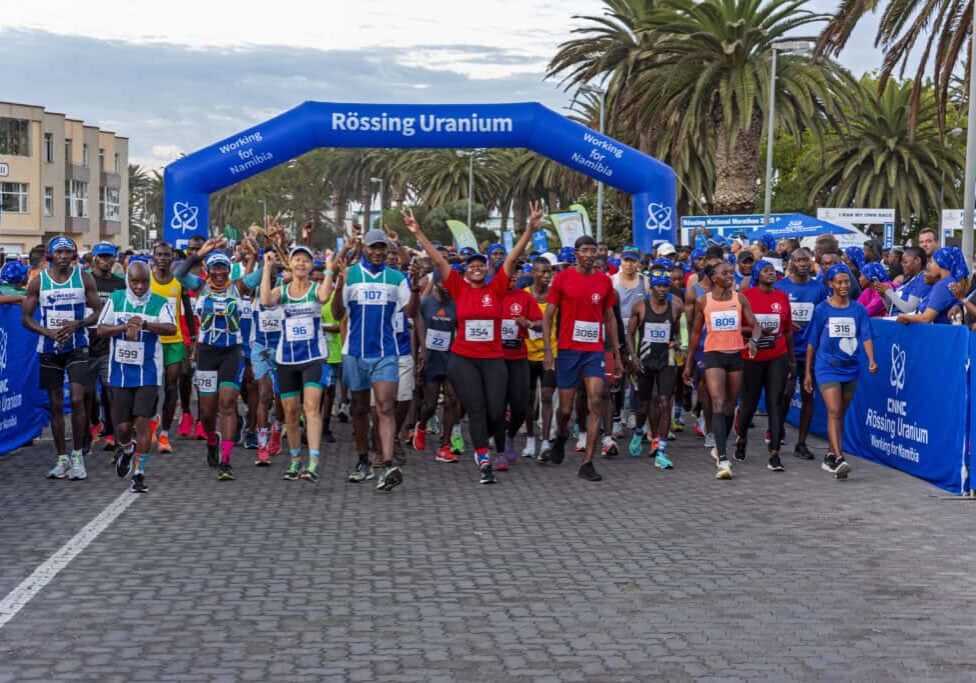
•   Seven athletes took part in the Rössing marathon, which is an incentive for more residents to participate in this annual event.

Health           

A total of 17 Arandis participants were trained in rendering home-based care; caring for people living with HIV/AIDS and malaria; the use of condoms and femidoms; dealing with stigmatisation; and sustaining sexual and reproductive health.

Orphans and other vulnerable children

The Rössing Foundation, with other major stakeholders, formed a forum for orphans and other vulnerable children (OVCs) in Arandis. The Foundation also participated in assessing the situation regarding these children in the town, and in mobilising the community in respect of care-giving and in how to deal with the HIV/AIDS pandemic.

Plans for 2007

•  The Rössing Foundation will increase support to schools by providing qualified subject experts in English, Mathematics, Science and Education Foundation, in order to meet its target of improving the overall pass rate in partner schools by 10%, to improve learners’ pass rates by 10%, and encourage them to obtain more As, Bs and Cs in their work by the end of 2007.
•  The aim is to build three computerised Mathematics centres and three Science laboratories in Arandis, Swakopmund and Ondangwa by the end of 2007. These centres will assist learners and teachers alike with improving their knowledge and skills, and will contribute to a better education system in Namibia.
•  Partial financial support will be provided to teachers who are committed to improving their educational knowledge and skills in
     English, Mathematics, Science and Education Foundation, either at diploma or degree level.
•  The After-school Development Programme that will be run and managed by full-time experts from the Rössing Foundation will start operating from mid-2007 and will provide opportunities for young people to improve their qualifications at Grade 10 and 12 levels. The programme will also support formal school learners through the computerised Mathematics centres and the Science laboratories.
•  The introduction of leadership training initiatives in 2006 aims to contribute to a Town Council and schools that will be managed more effectively by 2009.

Conservancies

The Ohungu Conservancy was registered with the Ministry of Environment and Tourism and would be officially launched by March 2007.

A leadership training course was conducted in Omaruru and covered knowledge of skills in leadership, good governance, and the day-to-day management of a conservancy. Ten beneficiaries attended the training.

Small-scale Miners Project

The Erongo Region is a mineral-rich territory that has many small mining communities carving out an existence by mining various minerals and gemstones. The environment in which these small-scale miners work is notoriously harsh and dangerous and they sometimes live in the mountains for days, digging for minerals and gemstones without the most basic necessities such as clean water, access to health facilities, protective clothing or adequate equipment.

The sustainability of these miners has become a project that Rössing embarked on in 2006, together with other stakeholders in the Region. At the beginning of the year under review, a strategic marketing meeting was held at the mine as a first step towards discussing alternative plans and ideas to make the enterprises of these miners more sustainable and marketable.

Health and safety became additional operational areas, focusing specifically on HIV/AIDS.

Education Support Programme

Reading is one of the major drawbacks in learners’ performance and this is due to poor foundations in the early stages of education provision.

All three schools in Arandis, namely the Arandis Junior Primary School, the UB Dax Senior Primary School, and the Kolin Foundation Senior Secondary School, continued to receive support from the Rössing Foundation during 2006.

In conjunction with English teachers from the Kolin Foundation Senior Secondary School, the Foundation offered special reading classes to 58 Grade 8 learners, who up until then had been reading at Grade 4 levels. In addition, the Foundation sponsored consultants who worked with ten Grade 1–5 teachers to build a strong foundation in reading, numeracy and science. Additional reading lessons were also offered to Grade 1–5 learners at the Arandis Junior Primary and the UB Dax Senior Primary Schools. Twelve teachers and 150 learners benefited from this support.
As regards Early Childhood Development (ECD), 45 teachers were trained in order to be able to increase their learners’ reading competencies at a fundamental level, namely preparing pre-primary learners for primary school.

Over 400 learners were assisted by two experts in both English and Mathematics attached to the Kolin Foundation Senior Secondary School and the UB Dax Senior Primary School during 2006.

The Rössing Foundation contracted teachers around the Erongo Region for the Spring School held in August 2006 at both Arandis and Omaruru. In total, 166 Grade 10 and 12 learners from the Kolin Foundation Senior Secondary School and the SI Gobs Secondary School in Omaruru benefited from the upgrading programme in the areas of English, Mathematics and Science.


Home Page  | Contacting us  | Links to other sites  | Legal Notice  | Site Map
Copyright © 1999 - 2008 Rössing Uranium Mine