|
|
|||
|
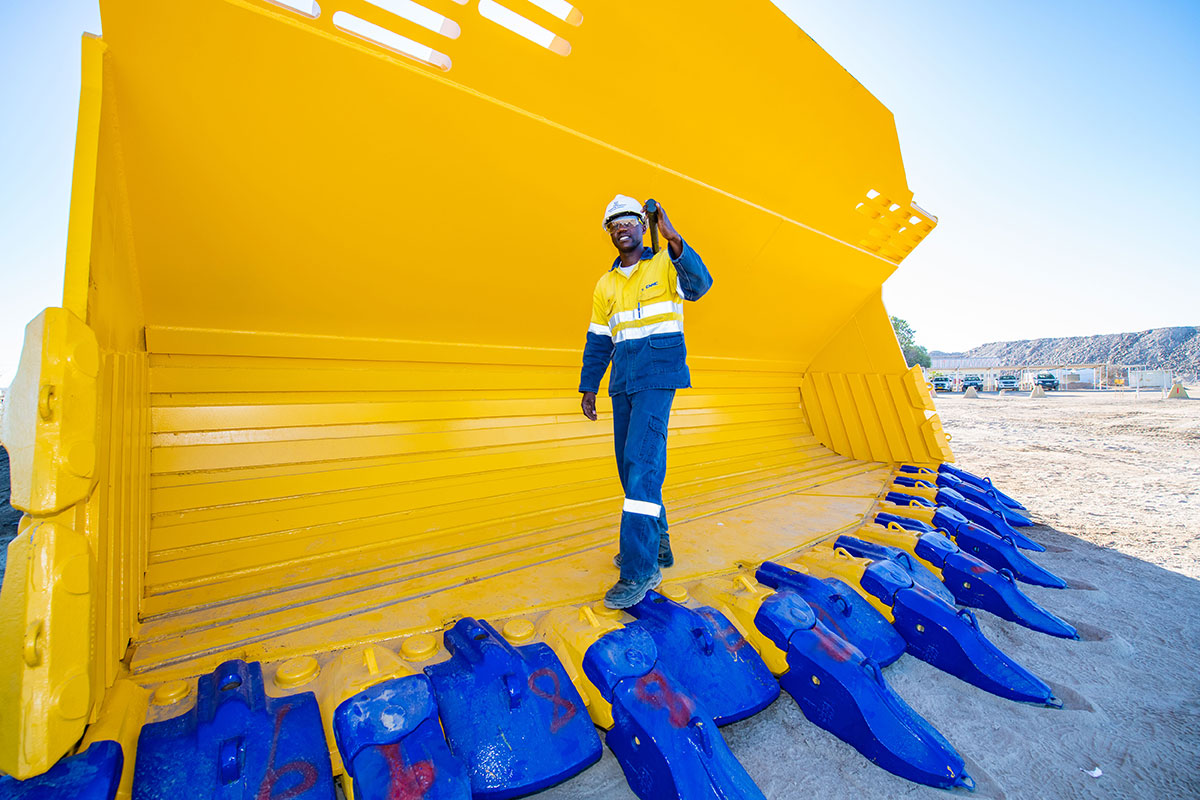
ASSET USE RESOURCE STEWARDSHIP Mining The year 2007 was an exciting one for Mining. New employees were successfully introduced in order to ramp up from 19 million tonnes mined in 2006 to 31 million tonnes mined in 2007, and to prepare for a further ramp-up to 48 million tonnes. A number of new equipment items were commissioned in 2007, including two Komatsu PC5500 shovels, a Caterpillar 994 front-end loader, eight 730E Komatsu haul trucks, a Pit Viper production drill, and two D10T track dozers, while one GD120 production drill and a Marion 201M shovel underwent a major overhaul. Although the business focused on expansion and growth, Rössing’s foundation is to ensure continued uranium production in order to satisfy long-term uranium supply contracts with global customers. Thus, while waste stripping was continued, ore mining concentrated in the eastern sections of the pit. The waste rock removed increased from 16.8 million tonnes in 2006 to 21.4 million tonnes in 2007, while 12.6 million tonnes of ore were processed. In 2007, 571 tonnes less uranium oxide were produced, compared with the 2006 production year. This was mainly attributed to a 21% drop in ore grade. In the mining area, a number of challenges had to be overcome. As the pit has significantly deepened and narrowed in the last few years, it took longer to get from pit bottom to ground level. Manoeuvring haul trucks with large turning circles becomes more difficult the narrower the pit bottom gets. Also, more water than before was found in blast holes at the lowest mining bench, making blasting increasingly difficult. Consequently, less material was produced in similar time spans. Processing The Processing Department is responsible for extracting the uranium from the mined rock, producing uranium oxide, and securely packing and shipping the product to converters overseas for further processing. In the Processing Plant, for example, the Life-of-Mine Extension Project includes upgrading the outdated electrical systems over the next four to five years, upgrading the systems that prevent expensive resins going to waste, and upgrading the dust extraction systems to reduce air emissions of silica-bearing and radioactive dust. Planning, studies and preparation for these projects continued during 2007. In 2007, work also continued in respect of testing the feasibility of an ore-sorting pilot plant. The plant aims to make the sorting of waste rock from uranium-bearing rock more efficient The Metallurgical Laboratory was refurbished and upgraded to the required standard in 2007. Independent auditor, customer and consultant reports highlighted the improved performance in the laboratory. Engineering The introduction and implementation of the Asset Management Improvement (AMI) Project throughout the mine was the year’s principal challenge. This project first assessed the mine’s status quo, and then analysed the gap between the status quo and the mine’s estimated future position. A road map was then developed to chart the course ahead.Both Processing Plant and Mining Operations personnel will focus on fully implementing the ‘Operating for Reliability’ lessons learnt as part of the AMI Project. This will improve the way we manage our assets, and will, in turn, increase productivity and equipment life. The Maintenance teams also focused on improving defect elimination and the reliability engineering aspects of asset management. The aim is to eliminate repeat failures and look at ways of improving and optimising asset management so that equipment availability and the reliability continue to improve. This will ultimately assist in meeting production targets, and the AMI Project will be instrumental in achieving this goal.
|
“The Mining Department increased the total tonnes of ore mined in 2007 by 50% compared with the previous year. The Mining team responded well to the challenges, which included the introduction of new people, mining in very confined areas, and commissioning a lot of new mining equipment.” “Considerable progress has been made in 2007 in recruiting graduate metallurgists, foremen and operators to deal with the many challenges in the Processing Department. The overall objective of the Department is to excel in various fields, mainly the processing of ore, consistently achieving targets and producing more than 4,000 tonnes of uranium oxide annually, undertaken without compromising our occupational health, safety and environmental standards.” “The strong planning and scheduling foundation laid under the Asset Management Improvement principles has already shown some fruitful benefits.” “2007 has been a year of consolidation in the Projects environment. It is trusted that this consolidated structure can be used as a foundation to build the required skills to accommodate the future for Rössing’s project management.”
|
||
|
Engineering projects In respect of programmes and finances – with consolidation of the Life-of-Mine Extension Project – 2007 was a busy year. The total amount approved for this project is N$772 million, excluding the funds required for the Aligning Business Systems (ABS) upgrade, and of this amount, 78% had been committed by the end of 2007 in completing 55 of the 85 sub-projects. Of the remaining project funds, approximately 76% will be utilised in 2008, 18% in 2009, and 6% in 2010 in order to complete the electrical upgrading of the mine. A study was done in 2007 on optimising and upgrading the Fine Crushing Circuit. The expenditure of funds was approved and the project awarded. This project will be implemented in 2008 and the challenge will be to attain the planned production, as the construction phase is estimated to take several months. One of the projects identified previously – and an important part of the Life-of-Mine Extension Project – is the building of an Acid Plant to provide the sulphuric acid required to extract the uranium from the ore. The relevant feasibility study has been completed and a contractor to build the plant will be selected. The EIA is also in its final stages of review. The project is to be submitted to the Group Investment Committee in 2008 for approval of funding. Work still outstanding is the handling of raw materials, such as sulphur, at the Port of Walvis Bay. In the recently completed Strategic Production Planning exercise, the need to further expand the mine’s production capacity was identified. The method being investigated for this expansion is heap leaching. The project is to test the process by building a heap leach test site. The preliminary designs of the heap leach test pads have been completed and approved. Funds are to be obtained for the implementation of the project in 2008. In 2008, the Department will focus on building capacity to handle critical projects, and align the processes with the changes brought about by the Aligning Business Systems.
|
|||
Home Page Contacting us Links to other sites Legal Notice Site Map |
|||