|
|
|||
|
ENVIRONMENTAL RESOURCE STEWARDSHIP Since Rössing recognises that its business activities have an impact on the environment in which it operates, it aims to minimise this impact. Through various environmental programmes, identified not only by Rössing but also through stakeholder engagement, areas of continuous improvement are identified. The International Organisation for Standardisation (ISO) 14001:2004 specifies requirements for an environmental management system to enable organisations to develop and implement their environmental policy and to manage their interaction with the environment. Adoption of this standard implies a constant commitment on the part of Rössing to improve its environmental monitoring and environmental performance efficiency. Environmental auditors Bureau Veritas conducted an external ISO 14001:2004 re-certification audit during the year under review. The certification body was satisfied that Rössing complies with all the ISO 14001:2004 requirements, which resulted in Rössing being certified as ISO 14001:2004 compliant for the period 2007 to 2010. Climate change With the growing concern globally about climate change, Rio Tinto has made a firm commitment to the reduction of energy usage and greenhouse gas emissions. This commitment has been passed on to all businesses within the Rio Tinto Group and Rio Tinto has made resources available to assist its businesses in achieving set energy and greenhouse gas reduction targets. In 2006 Rössing submitted its Climate Change Action Plan for 2007–2009 to the Rio Tinto Climate Change Leadership Panel. From this plan a number of activities were implemented:
|
|
||
|
Energy usage and greenhouse gas emissions Total energy usage at Rössing covers the consumption of both electricity and fuels. Consumption is expressed in Megajoules per tonne (MJ/t) of ore processed, to give a measure of energy efficiency for mining and production at Rössing. In 2003, Rio Tinto set a target for all its businesses of 5% reduction in total energy used per tonne of product by 2008. Although Rössing performed well in achieving its goals for 2004 and 2005 in terms of energy usage, it was unable to sustain this performance. With the approval of the Life-of-Mine Extension, it was recognised that Rössing would not be able to achieve the target set for 2008. In 2007, energy usage was 121.6 MJ/t of ore processed. This was well above the annual target of 108 MJ/t of processed ore set by the mine to conform to the Rio Tinto targets. The greenhouse gas emission for 2007 was 64.7 tonne CO2 equivalents per tonne of uranium oxide produced, with the target being 47.6 tonnes CO2 equivalents per tonne of uranium oxide produced. Therefore, during the year under review, Rössing failed to meet both the targets in terms of limiting greenhouse gas emissions and energy usage.
Recognising its future growth plans, Rössing re-evaluated the targets for 2008. Land use and rehabilitation During 2007, Rössing embarked on the implementation of the Rio Tinto Land Use Management Standard. For this, all documentation relating to the land used for the mine’s operations was entered into a database, and a geographical information system was established to produce the required maps and allow for forward planning. Included in the database are all important natural features within Rössing’s mining licence and accessory works areas. Data compilation was informed by a number of archaeological, ecological and groundwater studies carried out in 2006 and 2007. Rössing’s licence area will be divided into specific land use zones in 2008 to ensure that the effect of disturbance of new ground will be minimised as far as possible. Because most previously disturbed ground away from Rössing’s operational area had already been rehabilitated, no further rehabilitation work was carried out during 2007. Sand mining in a river bed close to the open pit and the related ground disturbance was halted during the year. In the past, ordinary sand was used to cover the mine roads, but this is now being replaced by tailings sand. Mining and waste disposal activities affected 10 ha of new land during 2007, and the total ‘footprint’ of the mine now stands at 2,395 ha – an increase of 0.4% on 2006. Unauthorised removal of gravel from an area close to the tailings facility resulted in the damage of some plants of conservation value. Specific disposal procedures will, therefore, be included in the land use management plan to prevent any unauthorised land use in future. The land use strategies and management plans will be completed and implemented in 2008, and will guide operations as well as planning for the new mine expansion areas. Water use The mine’s use of fresh water in 2007 amounted to 3,299,980 m3, or 9,041 m3 a day, while the operating plan made provision for 3,303,250 m3, or 9,050 m3 a day. The water consumption rate per tonne of ore milled was also on target, at 0.26 m3 per tonne .The Processing Plant and the associated tailings disposal operations are the biggest consumers of water at the mine. Tailings, which are the remaining crushed and milled ore rock from which uranium is extracted, are pumped at the tailings facility as a mixture of sand, fines and water. The free water forms a pond on the tailings facility from where it is recovered for reuse in the mills. The mine’s water demand depends mainly on the tonnage of ore milled, since much of the process solution soaks into the tailings material and remains there. The predicted freshwater demand for 2008 is 3.5 million m3 at the planned production and current consumption rates. The demand can, however, be reduced to 3.2 million m3 with the implementation of water-saving projects. Various projects were evaluated during 2007, taking into account uncertainties related to new potential processing methods and mine extension options. The two most promising initiatives are to cut the freshwater demand by 0.7 million m3 per year. The projects are installation of mechanical glandseals on certain slurry pumps, which will save glandseal water, and paddy double-deposition, which will reduce evaporation losses on the dam. The mine will, however, require additional dust suppression water for the extended mining areas, which will decrease the savings to 0.3 million m3 per year. Efficient freshwater use and supply The consumption of fresh water by bulk users and the status of the aquifers are monitored by the Namibia Water Corporation Ltd (NamWater) and the Ministry of Agriculture, Water and Forestry’s Department of Water Affairs (DWAF).
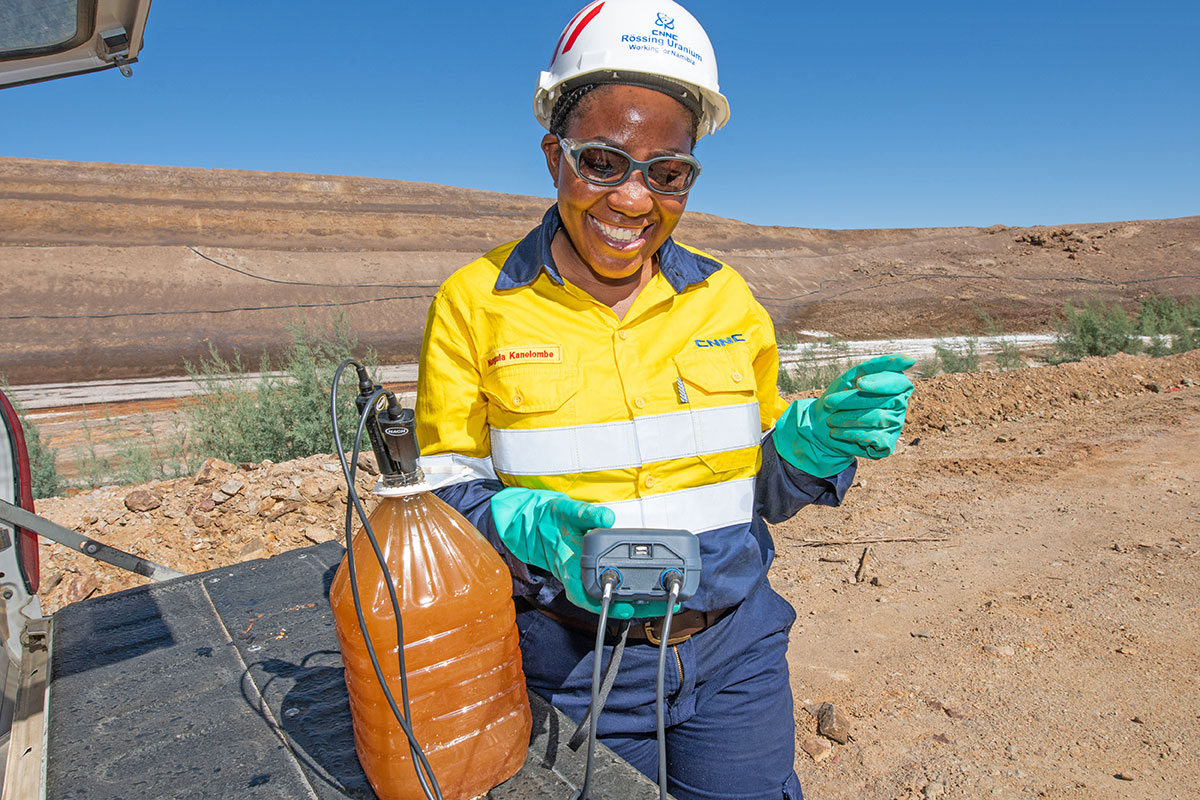
Pertinent results are currently provided to bulk users, and will in future be supplied to Basin Management Committees. The aim is to conserve groundwater resources by sharing information and promoting water demand management and/or sea water desalination. Saline water use and quality Mines located close to the Khan and Swakop Rivers are either already extracting saline groundwater for industrial purposes or are planning to do so. Excessive pumping might reduce the availability of water to the farming area along the lower Swakop River. A Water Management Committee, in cooperation with the DWAF, is planning to set up a regional monitoring network to measure water levels in these two rivers on a regular basis. A public concern related to uranium mining is the impact of process effluents on the water quality of neighbouring areas, especially the rivers. The DWAF and the Ministry of Mines and Energy’s Geological Survey Directorate are arranging an independent sampling exercise to establish the baseline water quality. The survey will cover monitoring boreholes close to and in the river courses. Each mine has or will have its own water quality monitoring programme and will report its analysis results to the DWAF, whose task it is to protect people and the environment from contamination caused by mining activities. Life-of-Mine Options Analysis – Expansion A Social and Environmental Impact Assessment (SEIA) has been commissioned for the proposed Life-of-Mine Extension Project. The SEIA requires stakeholders to be consulted and public meetings to be held. Rössing’s Planning Department focused on the mine’s expansion plans, which foresee the
Besides an emphasis on optimising design and maximising the value that the new projects will add to Rössing’s business, substantial work was completed during 2007 to assess the social and environmental impacts these projects are likely to have. To this end a number of public meetings were held throughout the year to inform the public and stakeholders about Rössing’s expansion projects, so that informed comments and concerns could be brought to the attention of the project managers. Aspects identified through this process were researched to develop measures that would allow for the avoidance or minimisation of negative impacts. The impact assessment report for the acid plant and mining project was submitted to the Ministry of Environment and Tourism early in 2008. The report recommended that environmental clearance should be issued to Rössing Uranium to proceed with the projects. The main issues that were raised by the stakeholders relate to the cumulative impacts of potential new mines opening in the Erongo Region, following intensive mineral exploration after an upturn in the world uranium market. Specifically, the supply of water and electricity and the positive and negative aspects, in general, of many new people coming to the Region were highlighted. Since Rössing cannot address these cumulative issues on its own, the work of the Chamber of Mines of Namibia was substantially supported in order that an office could be established in Swakopmund, and for a Principal Advisor on Radiation Safety to be employed. During 2008, the Chamber of Mines will facilitate the development of a regional management plan to address the cumulative aspects of the current mining boom. This plan will be informed by a Strategic Environmental Assessment (SEA), which is being initiated with financial and technical support from all uranium mines and exploration companies currently in the Region. External incidents reported During the offloading of a Rössing shipment at the Port of Montreal, a container was dropped. It hit another container and pierced the vessel below the water line. Water entered the ship while the seven Rössing containers were still on the vessel. A team from Rössing was sent to Montreal to carry out an inspection in order to ensure the integrity of the packing for the onward journey to the Honeywell converter in the USA. On inspection it was found that, in all the containers, the water level had not risen above the product drum lids, and very little water remained in the containers. The drums in the container that had fallen had indeed been damaged, but all the drums were still securely sealed and no product had been spilled. The drums were removed from the damaged container and repacked in another. All strapping of the other six containers was intact, with no drum disturbance. On these containers the damp areas were dried and packets of desiccant Closure planning After the major update of the closure plan in 2005 in order to prepare for closure in 2009, the mine is now planning for expansion beyond 2026. Hence, in 2007, only a financial update of the previous plan was done. The total closure cost projected for the mine in 2007 terms stands at just over N$800 million. This includes retrenchment and training costs, demolition and tailings rehabilitation, and long-term seepage control and monitoring costs. The provision for closure in the Rössing Environmental Rehabilitation Trust Fund stood at N$91 million at the end of 2007, and will be increased during the coming years to provide fully for mine closure when the time comes.
|
|||
Home Page Contacting us Links to other sites Legal Notice Site Map |
|||