Home Page | 2007 Report Verification | 2003–2007 Performance | List of references | Your contacts
Links to other Sites | Rössing's Business - 2007 | Rössing Management | Message from MD | People
Communities | Sustainable development | Economic viability | HSE Policy | Chamber of Mines of Namibia | Product Stewardship
Environmental Stewardship | Asset use resource stewardship | Corporate Governance | Mining Uranium & Nuclear Fuel Cycle

External Affairs
The Rössing        Foundation
Environmental        Stakeholder        Engagement
Environmental        Education


HomeCommunities › External Affairs

COMMUNITIES

External Affairs


It is with the appreciation and understanding of the need for public consent that Rössing deemed it necessary to establish an External Affairs department to be the custodian of its corporate image, and to establish and manage mutual understanding between the company and its stakeholders.

The principal challenge of the newly established department was to put systems in place to ensure smooth operations and due recognition of its revamped function within the company.

Overall, Rössing continued to enjoy positive coverage in the media, while the community continued to commend its proactive community relations efforts in Arandis and other areas within which the company operates. Donations and sponsorships were instrumental in forging a positive image.

Donations and sponsorships

Rössing’s direct donations in 2007 amounted to N$5.8 million, which was less than the N$8.7 million in 2006 when the mine celebrated 30 years of production. Additional donations and sponsorships were made in Arandis. The main purpose of this programme in 2007 was to assist community groups in Arandis, Swakopmund and Walvis Bay as well as in the rest of the Erongo Region with community activities that would promote community development.

Community consultation: Arandis

For 2006/7, the focus of community actions was the sustainability of the town of Arandis beyond the life of the mine. As of 2008, the scope of the mine’s community activities will broaden, with the focus shifting to other communities on whom the mine has an impact. The town’s governing body has been prepared for this eventuality, with agreements
working at skills transfer and establishing support structures owned and managed by the Arandis Town Council.

In 2005, Rössing started a process with The Rössing Foundation and the Arandis Town Council whereby the sustainability of the town beyond the life of the mine was assessed. A baseline study carried out as a precursor to the activity highlighted
the town’s dependency on the mine and its related activities, such as –

  • mine employees who lived at the town
  • semi-skilled residents involved with contracted companies on the mine site, and
  • a perception among some residents that upon mine closure they would have to leave Arandis and go back to their communal lands or move to another town.

From this process, the Arandis Sustainable Development
Project (ASDP) was born.

The year under review saw a definitive shift in involvement and management of the ASDP, the first aspect of which being that the Arandis Town Council was to contract all consultants for the projects that would be commissioned. These focused on the Water Management Project, management of the sewage plant, and the development of human resources.

With input from the mine in terms of strategic and engineering knowledge, the Water Management Project has now progressed to a stage where the grey water supply pipelines have been replaced, and work on the sewage plant has progressed to the extent that the Council will be able to cope with the possible projected increase in population
numbers as a result of the related increase in mining activities in the area.

A position for a Liaison Officer was created within the Town Council, initially on a contract
basis only, in order to take responsibility for local economic development and the documentation of the ASDP’s processes. The Council’s long-term planning will absorb the functions of this position into its organisational structure.

Related to this activity, a revised structure to meet the needs of an expanding town has been approved for the Council, job descriptions were compiled for the existing and new positions, and updated performance based job descriptions have been compiled. The Council’s senior management are currently undergoing leadership training.

Visitors’ programme

Rössing’s visitors’ programme continued as a format for sharing information between the mine and the public as well as with specialised groups. The information sharing focused on mine operations, especially its extension and expansion projects, the nuclear industry, and uranium as a source of energy.

The total number of visitors in 2007 was 2,015 (compared with 1,933 in 2006). The programme includes general public tours twice a month; various
local, regional and national Government delegations; local and overseas student groups, mainly in the fields of geology and mining engineering; and various visits from national and international print and electronic media groups.The objective for 2008 is to expand the visitors’ programme by targeting identified interest groups.


“New mines in the surroundings of Arandis are posing very challenging times but with enormous opportunities for the town. These opportunities, however, should not be seen as creating a dependency, but rather as boosting the economy of Arandis. The Council has prepared itself well to accommodate the new mines. A new township establishment is in the pipeline that will cater for residential and commercial development. With regard to the Arandis Sustainable Development Project (ASDP) set up in 2005 after a baseline study, we are continuing with vigour to make Arandis a sustainable town. We recently launched a very exciting part of the project, namely the Local Economic Development Strategy. During this process we invited various stakeholders, of which the mines were probably the key group, for their input. This whole process was aimed at fostering a relationship between the Council and the mines: not asking what the mines could do for the town, but how, jointly, we can support economic activities to ultimately ensure that Arandis can become sustainable. I’m also of the opinion that this strategy we are busy adopting – which does not exclude the community, I must emphasise – will enable us to create an identity for the town and ensure the implementation of our vision to make Arandis a town of choice.

It is important to say that, with all the mining activity happening around Arandis, there is such an abundance of opportunities available. As the Town Council, we really want to join hands with all the mines to ensure that these opportunities are utilised to the benefit of the residents and all parties. We don’t want to establish or promote a dependency on the existing or new mines. It is vital for us not to approach any opportunity that the increased mining activities in the area might offer with a sense of dependency.

Council also recognises the community as very important stakeholders and we are doing everything in our power to involve them in all the processes pertaining to the development of the town. The Council is also preparing itself internally for the challenges ahead. This we are doing by way of capacity building programmes. We have already started with leadership development, and are currently busy with succession planning; so we are really strengthening the internal capacity to cater for the demands that are coming.

One can definitely feel the change amongst the residents: there’s a new vibe, especially in terms of employment. I think if people are unemployed, they become very desperate and resort to all sorts of negative things. But one can already see there is a positive attitude. When the community consultation took place with regard to the Local Economic Development Strategy, the community’s attitude was very positive: they want to see things happening. And things are going to happen! In the past, the banks have never really supported Arandis. But Bank Windhoek has now committed itself to opening a permanent branch, targeting July this year [2008]. This is already an indication of the commitment that other stakeholders have made to really come and settle in the town. So, overall, the future of Arandis looks bright.”

FLORIDA CLOETE
Chief Executive Officer, Arandis Town Council

“Every organisation that thrives on broader stakeholder support for successful business requires public consent as a social licence to operate, and public consent is an outcome of deliberate communication interventions.”

JEROME MUTUMBA
Manager: External Affairs


Rössing donated a vehicle and computer equipment to the Namibian Police
at Arandis to assist them in the execution of their tasks. The mine’s Manager of External Affairs, Jerome Mutumba, handed over the donation to the Arandis Police Station Commander, Warrant Officer Erich Nghaamwe, (left) and Chief Inspector of the Swakopmund Police, Otillie Kashuupulwa (right).


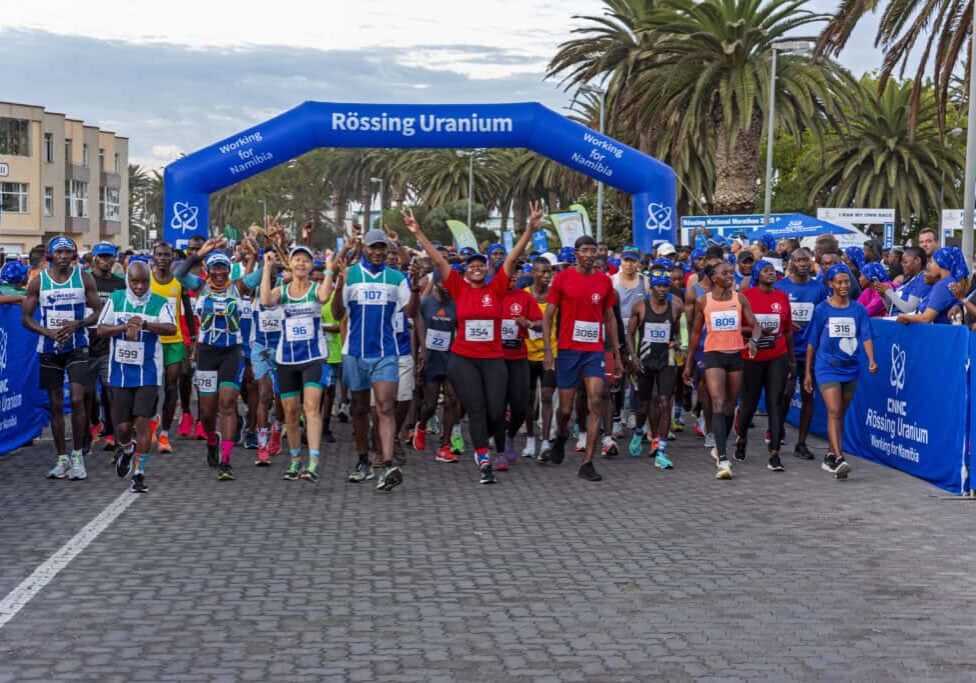
The annual Rössing marathon forms part of an active recreational programme facilitated by the mine and supported by its employees and the Erongo communities


A ground breaking ceremony, attended by the Founding President and Father of the Nation, Dr Sam Nujoma, was held at the Uiba-Oas Small Miners Cooperative at the T-junction between the Henties Bay and Swakopmund roads. The community, consisting of about 43 adults, has resided at the T-junction for the past ten years and faces severe challenges. Several stakeholders joined hands to assist the community with their first gemstone display area.


The Erongo Small-scale Miners’ Association
received a vehicle donated by the mine.
Petra Ondingo of The Rössing Foundation handed the keys to Chris Timbo, chairman of the Association. Transport is a major challenge for the small-scale miners who live and work in rural areas, mainly around the Spitzkoppe.


Rössing donated N$100,000 in support of the House of Safety at Swakopmund. Mr Asser Kapere (left), chairman of the Erongo Development Fund, accepted the donation from Rehabeam Hoveka (right).


Delegates attending the technical meeting of the International Atomic Energy Agency (IAEA), the world’s centre of cooperation in the nuclear field, visited the mine site in October 2007. It was the first time that the IAEA had held a meeting in Namibia and Rössing Uranium was the proud host of their week long discussions in Swakopmund.


As part of its commitment towards
training and development, Rössing hosted a tour for The Rössing Foundation staff.


Home Page  | Contacting us  | Links to other sites  | Legal Notice  | Site Map
Copyright © 1999 - 2008 Rössing Uranium Mine